Original: $13.90
-70%$13.90
$4.17The Story
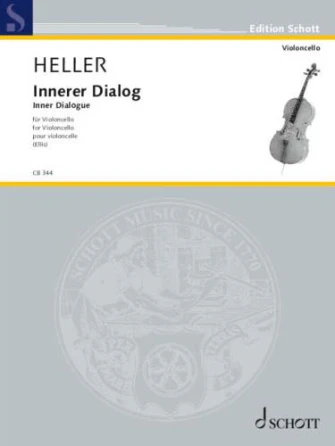
Barbara Heller composed Inner Dialogue with a musical material consisting of several interval series arranged in a dialogue-like manner. The composer focuses on ascending and descending movements. Barbara Heller writes:
“I was particularly emotionally connected to one series of intervals, which can be found at the beginning of the second part (Lento)and the fifth part (Calmo): major sixth, minor second, fourth, major second, and tritone. This falling sixth triggered in me the attempt, after the semitone downward step, to climb back up with a rising fourth, and then back down again with the whole tone and the tritone – this resulted in an express ion that wouldn't let me go and touched me deeply. It was like a trap from which I couldn't escape. And so, as I worked on the cello piece, it became an inner dialogue: with the back and forth downwards and then upwards again, a kind of variation-like music that repeatedly – with small changes – was a self-questioning, an attempt to free myself from this 'motif,' which I failed to do.”
In this edition, the editor Beverley Ellis provides important suggestions for interpretation.
Description
Barbara Heller composed Inner Dialogue with a musical material consisting of several interval series arranged in a dialogue-like manner. The composer focuses on ascending and descending movements. Barbara Heller writes:
“I was particularly emotionally connected to one series of intervals, which can be found at the beginning of the second part (Lento)and the fifth part (Calmo): major sixth, minor second, fourth, major second, and tritone. This falling sixth triggered in me the attempt, after the semitone downward step, to climb back up with a rising fourth, and then back down again with the whole tone and the tritone – this resulted in an express ion that wouldn't let me go and touched me deeply. It was like a trap from which I couldn't escape. And so, as I worked on the cello piece, it became an inner dialogue: with the back and forth downwards and then upwards again, a kind of variation-like music that repeatedly – with small changes – was a self-questioning, an attempt to free myself from this 'motif,' which I failed to do.”
In this edition, the editor Beverley Ellis provides important suggestions for interpretation.